Category / Application Architecture
Vertical
Inference
System intelligence beyond the model.
The application, model runtime and live inference state become one programmable system.
Vertical Inference is an application architecture in which model execution becomes resident application state. Ordinary code governs how intelligence retrieves, reasons, acts and continues while it is underway.
Lloyal is the platform for building and deploying this architecture—from local applications to frontier compute.
Inspect a working TypeScript application ↗One application contract, from product surface through live model execution.
EDGEQwen 3.5 · 4B
on-device
4B → APP
planning · agents
tools · recovery · synthesis
tools · recovery · synthesis
ONE APPLICATION
preflight()
plan()
agentPool()
policy()
synthesize()
commitTurn()
agent:spawn
same program · same AgentApps · same event contract
FRONTIERGLM-5.2 · 2×B200
hosted
10 → 1
ten live agents
one model dispatch per step
one model dispatch per step
Two real runs. One flagship application built on Lloyal, spanning both extremes.
01 / THE HARNESS
The harness is the intelligent application.
You already know how to build this: MVC, with a live LLM as the Model. Product surfaces are the Views. The harness is the Controller—ordinary TypeScript defining how the application's intelligence collaborates, acts, recovers and continues. Beneath it, a resident LLM holds the live generative state.
Views
CLI · Desktop · Webproduct surfaces
Controller
Your harnesstypescript · policy · capabilities · control flow
Model
Resident LLMshared context · live branches · generative state
The model supplies the intelligence. The harness supplies the institution.
This is what the Controller looks like:
incident-harness.tsTypeScript + Effection
export function* incidentHarness(incident) {
  const evidence = yield* parallel([
    inspectTelemetry(incident),
    searchServiceHistory(incident),
    reviewTechnicalManuals(incident),
  ]);

  const assessment = yield* reconcile(evidence);

  if (assessment.requiresApproval) {
    return yield* requestOperatorDecision(assessment);
  }

  return yield* proposeRemediation(assessment);
}
shared live contextstructured cancellationpolicy-governed actions
02 / AGENTAPPS
Intelligence needs contact with reality.
AgentApps connect the harness to documents, browsers, feeds, enterprise systems and tools. They can retrieve evidence, observe changing state and perform authorised actions. The harness determines when they run, which live lineage receives what they return and what consequence is permitted.
Retrieve
Acquire and evaluate evidence across search, corpora, documents and databases.
Observe
Read the world as it changes through browsers, feeds, telemetry and application state.
Act
Produce permitted consequence through computer use, workflows, APIs and operational tools.
AgentApps are signed, portable capability contracts combining Skills · Live Sources · Tools · Grants · Protocol
AgentApps provide contact with reality. The harness supplies procedure and authority.03 / BUILD
Build your first harness.
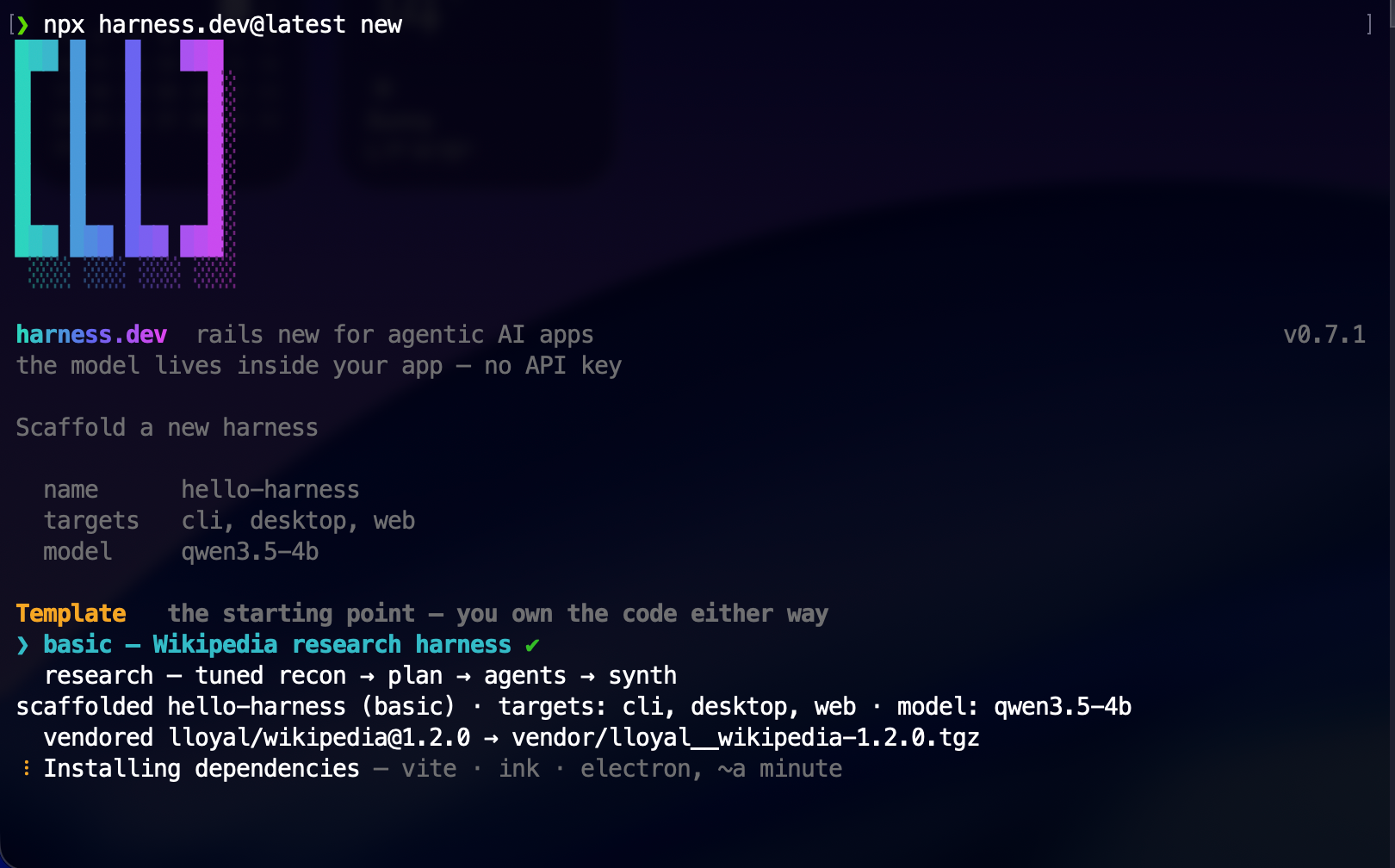
Scaffold a complete intelligent application: procedure, AgentApps, product surfaces and a resident model.
$
Read the ten-minute guide →
npx harness.dev@latest newharness.devguided application scaffold
FOR PRODUCT TEAMS
Make one high-value capability native to your product.
Work with Lloyal to turn a consequential workflow into a production harness—integrated with your existing product, connected to the systems it depends on and deployable across the environments your customers require.
One product capabilityOne product integrationPrivate AgentAppsMultiple placements6–10 weeks